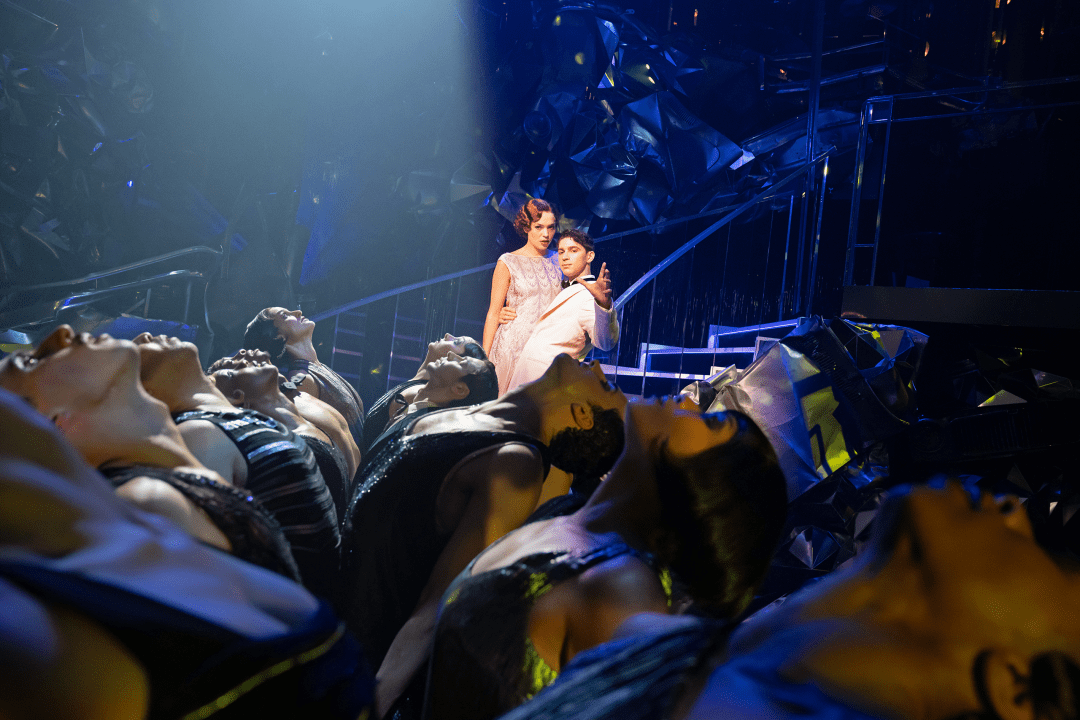
Dazzling scenes, heart-wrenching lyrics, and gritty commentary on the American Dream— these are just a few things that bring Gatsby: An American Myth to life at the American Repertory Theatre.
While audiences may question what’s the need for another adaptation of the 1925 F. Scott Fitzgerald novel, The Great Gatsby, this world premiere production does something different: it humanizes frivolous characters.
But this is not your high school English class’s Gatsby. This new production, with music by Florence Welch of “Florence + the Machine” and Oscar and Grammy Award-nominee Thomas Bartlett, a book by Pulitzer Prize-winner Martyna Majok, direction by Rachel Chavkin, and choreography by Sonya Tayeh, juxtaposes grit with glamour.
Audiences may think they know The Great Gatsby, but this production adds a few new twists. Staged in an industrial-looking graveyard and outfitted with grand staircases and glittering curtains, Gatsby sets the scene for the unsettling tale. While the wealthy dine on elegant tables and party in glamour, they’re surrounded by intricately laid automobile pieces, a haunting omen of what’s to come.
The production’s choreography is a standout, combining movement reminiscent of the 1920s era with bold modern movement. Tayeh masterfully incorporates some Charleston moves with daring and hungry choreography, expertly drawing together class and degeneration.
This production’s strength comes from its strong score and lyrics. The solid musical foundation gives it ground to stand on with other bold choices. The lyrics, though very clearly written by Florence Welch, blend expertly into the musical theatre orchestrations of the piece. While Welch’s style is apparent, it does not resemble a jukebox musical.
Ben Levi Ross is a master storyteller, luring the audience into the world of Gatsby as Nick. He opens the production with “Welcome to the New World,” showcasing the lives of the unbelievably rich and unhappy. Though Nick doesn’t directly narrate this production, he acts as a constant, running back and forth from East Egg to West Egg, making company of the Buchanans, Myrtle Wilson, and Jay Gatsby.
Eleri Ward was born to step into Jordan Baker’s shoes, despite often acting as an echo for Nick as the two find themselves in the company of the Buchanan’s failing marriage. It would have been especially great to see more solo moments for Ward, as her voice naturally lends itself to the score so well.
Charlotte MacInnes stuns as the delusional Daisy Buchanan. MacInnes captures the audience in her hand with heartwrenching solo numbers “Golden Girl” and “I’ve Changed My Mind.” Playing Daisy comes with the unique challenge of balancing her pining for Gatsby and the life she never had to emotionally checking out of her relationship with Tom. MacInnes has wonderful on-stage chemistry with Issac Powell (Gatsby), making hope feel in reach before the production’s ill-fated ending.
Solea Pfeiffer humanizes the sultry Myrtle Wilson. Though Myrtle is typically only “the other woman” in many adaptations of the novel, Pfieffer adds depth and dimension to the character, giving her the motivation to chase after Tom Buchanan (Cory Jeacoma) in the first place. Myrtle and Wilson (Matthew Amira) are the epitome of the working class, dazzled by the illusion of the American Dream. Pfeiffer plays Myrtle with ease and has an excellent opportunity to showcase her vocal talent in “Valley of Ashes,” among others.
Perhaps the man the entire adaptation hinges upon, Issac Powell, effortlessly captures the smooth-talking, gentile nature of Jay Gatsby. Powell plays Gatsby as upbeat and cheerful, generous to his friend Nick, and hopelessly in love with Daisy. Powell’s performance is so tangible that it makes his ultimate fate even more heartbreaking. He captivates the audience with numbers like “Pouring Down” and “Mr. Nobody From Nowhere.”
This production questions the concept of the American Dream, and what the price of dreaming is for those weren’t born with wealth. While visually dazzling, this new production tackles deeper themes, pulling from beyond the veil of the roaring 20s, and making bold and daring choices with a story that has been adapted tirelessly.
And while audiences might ask if another adaptation of Gatsby is necessary, this one absolutely is.

 The Broadway Edit