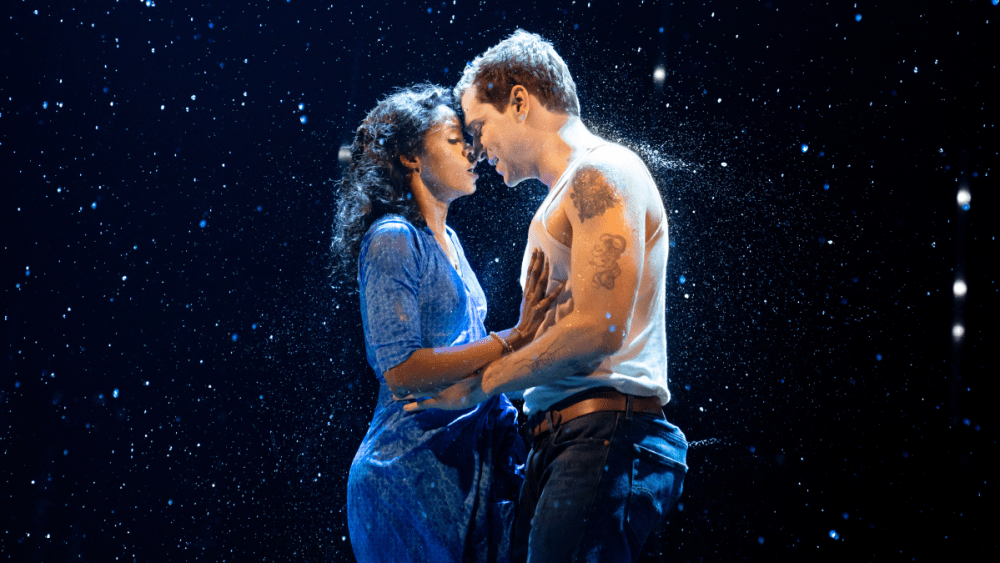
Leave the light on for The Notebook on Broadway.
Based on the Nicholas Sparks novel of the same name, the stage adaptation of The Notebook tells a love story that spans decades of a couple’s life. Told through the perspective of Allie and Noah in their older years reflecting on their life together, the story unfolds through their memories of how they grew together, apart, and back together.
Allie and Noah meet one summer as teenagers and quickly fall for each other. The young couple sees a future together; however, there is a natural conflict between the two due to social class and society. Allie is from a wealthy family with expectations that she will marry a man with the wealth to take care of her, while Allie wants to be with Noah because she loves him.
Then, nearly ten years later, Allie and Noah reconnect after losing touch for many years. After an incident in their youth that keeps Allie from seeing Noah, she goes to college and eventually meets Lon, who she intends to marry. Noah goes off to war and later returns to their town, changed in many ways. He’s unsure how to reacclimate himself to their small town. He buys the house he always promised Allie and starts working on the house to occupy his time. By chance, his picture is in the paper, leading Allie down to the house, where they see each other again for the first time.
Then, as Allie and Noah are in their later years, Allie is hospitalized for dementia, and Noah comes to visit her every day. The story is told from this perspective, as Noah promises to read Allie a love story from his notebook, which is actually their own love story that he has written down. As Allie’s health declines, Noah perseveres, even when Allie does not remember him or others.
This production breaks down the casting of Allie and Noah by utilizing three sets of actors to portray them at each stage of life. Jordan Tyson and John Cardoza portray younger Allie and younger Noah, Joy Woods and Ryan Vasquez portray middle Allie and middle Noah, and Dorian Harewood portrays older Noah. Happy McPartlin portrayed older Allie at this performance.
In particular, Woods and Vasquez give a striking performance as middle Allie and Noah, respectively. They capture the emotional middle crux of the relationship, and ultimately hold the will-they-or-won’t-they element of the story. Vasquez gives a strong performance in “Leave the Light On,” while Woods puts power into “What Happens.”
Overall, this production utilizes many facets to capture how love changes and grows through different stages and circumstances of life. Telling a story that spans over a significant period, especially on stage, is a challenge and one The Notebook takes on very well. Using different performers to portray the characters at different stages adds a bit of visual separation of the different stages of life and adds anonymity to the characters. While this is Allie and Noah’s love story, it is a very classic love story, and many people can see parts of themselves throughout.
The stage adaptation makes a few changes to the source material and varies greatly from the 2004 film adaptation. However, it still maintains some of the same beats, just reimagined for the stage. If you’re looking for Allie’s iconic line “If you’re a bird, I’m a bird” from the film, you won’t see it on stage or a row boat in the middle of a storm. These changes strengthen the production’s establishment as an adaptation versus putting the film on the stage.
Since it spans so much time, there are many significant beats in the story, some of which are hit or miss. In the stage adaptation, they don’t really establish what time period this is taking place in, and it’s hard to tell from visual cues, such as costumes or set design. This kind of throws parts of the story off, because it’s hard to place the events of the story. It’s hard to tell if this was intentional to attribute to the timelessness of the story, or if it just is a fault that is never clearly established.
Additionally, there is a heavy focus on negative events or memories that are significant to their relationship and not much emphasis on happy memories between Allie and Noah. It’s unclear if this was in an attempt to include many of the major beats from the original novel, but it felt like it was driving home some of the strain on their relationship instead of how their love had endured changes over time. The audience is being told this is a love story, so they must believe it’s a love story, but there are many moments where Allie and Noah seem disagreeable, which doesn’t exactly read as romantic.
Many of the technical elements of the production are what make it so striking. The scenic design is beautiful, uses pieces of a house to creates a world that the characters come back to over time. There’s a running stream on stage, which is interwoven into Allie and Noah’s story. And of course, the selling point of the production is the rainstorm that occurs on stage.
The music and lyrics, while beautiful and powerful, felt like they lacked individuality in the production itself. Many of the lyrics felt like generic love songs, which makes sense given that the music was written by Ingrid Michaelson, who has written many love song-type songs throughout her career. While the music was powerful and enjoyable, it missed the theatricality needed to cement an adaptation on stage.
It was also a bit surprising to see a story that is so affected by dementia and how that plays out on stage. That’s not something represented very often on stage, or even on screen, and it is definitely emotional to capture through storytelling. This is a powerful piece of the production and done alarmingly well by McPartlin and Harewood.
This is a great musical to see with friends or for a date night. Overall, it’s a strong middle-of-the-road musical, but it’s great for the hopeless romantic types, or anyone who enjoys the romance genre.

 The Broadway Edit